

Brain tumours can be benign or malignant. Their symptoms, diagnostic methods, surgery and additional treatment options are explained in patient-friendly language.
What is a brain tumour?
A brain tumour is an abnormal collection of cells that develops in the brain tissue, the membranes surrounding the brain, the skull base or the cranial nerves. Tumours can be benign or malignant; they can also form when cancer from another organ spreads to the brain (metastasis). The type, location and growth rate of the tumour are the most important factors determining the treatment plan.
Grouping by location
- Supratentorial tumours: These are located in the upper part of the brain (the cerebral hemispheres).
- Infratentorial or posterior fossa tumours: These are located in the lower back part of the brain, around the cerebellum and brainstem.
- Suprasellar and skull base tumours: These are located around the pituitary gland and at the base of the skull; they are close to the visual pathways and vital structures.
The most common tumour types include glioma, meningioma, nerve sheath tumours (schwannoma) and pituitary adenomas.
Brain tumours: symptoms
The symptoms vary with the location of the tumour; some tumours can grow for a long time without causing any complaints. Common symptoms are:
- Headache that increases over time or is more noticeable in the morning
- Nausea and vomiting
- Seizures
- Weakness or numbness in an arm or leg
- Problems with vision and speech, balance problems
- Changes in personality or behaviour, forgetfulness
Most of these symptoms can also occur for other, more common reasons. Even so, new and persistent complaints should be assessed.
Brain tumours: how are they diagnosed?
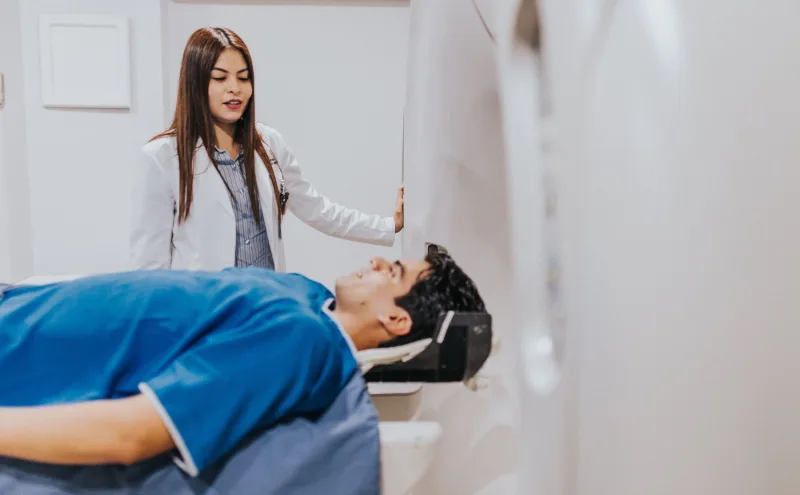
After a neurological examination, the most important diagnostic method is contrast-enhanced magnetic resonance imaging (MRI). Computed tomography (CT) can be used in emergencies or to assess bone structure, and advanced tests such as angiography, functional MRI or PET can additionally be used for surgical planning. The definitive diagnosis is made by pathological examination of the tumour tissue.
Brain tumours: treatment options
The treatment decision is made according to the type, size and location of the tumour, the symptoms and the person's general health. In many cases, neurosurgery, oncology, radiation oncology and radiology make a joint assessment.
- Monitoring: Small tumours that cause no symptoms and are thought to be benign can be followed with regular imaging.
- Surgery: The aim is to remove the tumour safely while preserving nerve function as far as possible, to reduce pressure on the brain and to obtain tissue for diagnosis. Some tumours can be removed completely; in others, only part can be removed because of their proximity to surrounding tissues.
- Radiotherapy and radiosurgery: These can be used in addition to surgery or when surgery is not suitable.
- Chemotherapy and targeted drugs: These are planned by the oncology team according to the type of tumour.
- Supportive treatments: Medicines that reduce brain swelling, anti-seizure medicines and rehabilitation.
How is the operation performed?
The operation usually begins with a craniotomy: the scalp over the area where the tumour lies is opened, a piece of the skull called a "bone flap" is removed and, if necessary, the tough membrane surrounding the brain (dura) is opened. The tumour is removed with the help of an operating microscope, navigation and, where needed, nerve monitoring methods. The dura is then closed, the bone flap is put back in place and the skin is stitched. In some patients, awake surgery or endoscopic methods may be used. Some tumours located in the pituitary region and skull base can be reached endoscopically through the nose.
The aim of the operation is to remove the tumour within safe limits and to preserve function; no definite prediction can be made about the outcome of the operation.
Possible risks and the recovery process
Every brain operation carries risks such as bleeding, infection, damage to brain tissue, brain swelling, seizures, temporary or permanent neurological deficits, cerebrospinal fluid leak and the need for further surgery. These risks differ according to the location of the tumour and the individual and are discussed in detail with your doctor before surgery. Close monitoring may be needed for a while after surgery; rehabilitation programmes such as physiotherapy, speech therapy and occupational therapy support recovery. Further treatment is planned according to the pathology result, and regular MRI follow-up is carried out.
Brain tumours: frequently asked questions
Does everyone with a brain tumour need surgery?
No. The type, location and size of the tumour and the symptoms determine the treatment decision. Some tumours can be monitored; in others, medication or radiotherapy comes to the fore.
Can the whole tumour always be removed?
Some tumours can be removed completely and safely; in others, only part can be removed because of their proximity to surrounding tissues. This is discussed together before surgery on the basis of the imaging.
How long is the hospital stay after surgery?
The length of stay depends on the type of operation and the person's recovery. The post-operative monitoring and rehabilitation plan is made by your doctor.
Brain tumours: when should you seek care?
A specialist examination is needed for complaints such as headache that increases over time, a new seizure, problems with vision or speech, weakness in an arm or leg, or a change in behaviour.
Go to the nearest emergency department in the case of a first seizure, sudden clouding of consciousness, a sudden severe headache, inability to speak or sudden weakness on one side of the body.
Brain tumours: what happens at the consultation?
You will be asked about your complaints, how long they have lasted and any accompanying symptoms. A neurological examination is performed and any MRI and CT images are reviewed. The necessary additional tests are planned; once the diagnosis is clear, the treatment options are shared with you.
The information on this page is for general information only; an examination is needed for a diagnosis and treatment decision. Every patient's situation is unique.