

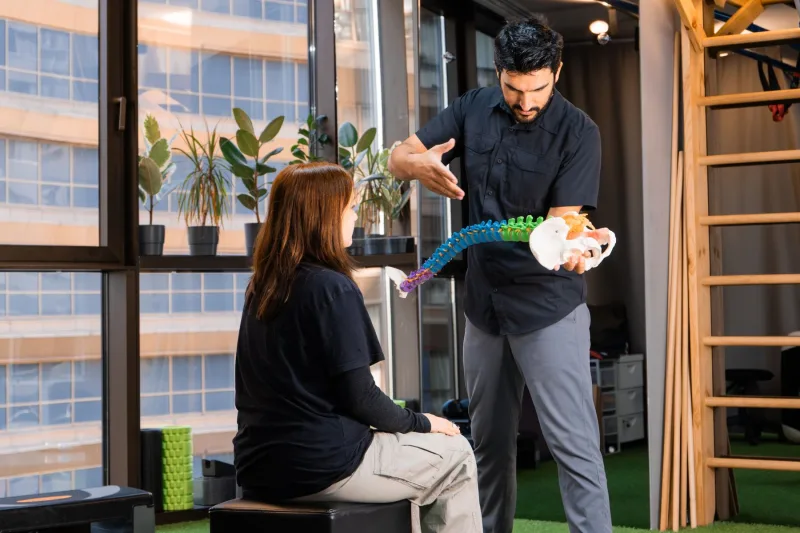
The main causes of low back pain, pain radiating to the leg, what helps at home, the steps of treatment, and when to see a doctor or go to the emergency department.
Low back pain is a complaint that almost everyone experiences at some point in life. Most of the time it is caused by strain on muscles and ligaments and improves markedly within a few weeks. Sometimes, however, there is a problem with a disc, a joint or a nerve behind the pain. On this page, we explain the main causes of low back pain, what pain radiating to the leg means, what can be done at home and the steps in which treatment progresses. Under each heading, we also point you to our pages that cover the topic in detail.
What causes low back pain?
Low back pain does not have a single cause. The spine is made up of vertebrae, the discs between them, small joints, ligaments, muscles and nerves. Each of these structures can be a source of pain. The main causes are:
- Muscle and ligament strain (mechanical pain): This is the most common cause. It starts after heavy lifting, a sudden twisting movement or staying in the same position for a long time.
- Disc problems: The loss of water and wear of the discs with age is called disc degeneration. When the inner part of the disc bulges out and presses on a nerve, this is called a herniated disc.
- Facet joints: These are small joints that connect the vertebrae to each other at the back. They can cause pain through arthritis and wear.
- Sacroiliac joint: This is the joint between the sacrum, at the lower end of the spine, and the pelvic bone. Pain coming from here is usually felt in the upper part of the buttock.
- Spinal stenosis: This is the narrowing over the years of the canal through which the nerves pass. Spinal stenosis typically shows itself as pain and tiredness in the legs that increase with walking.
- Spondylolisthesis: This is when one vertebra slips forwards relative to the vertebra below. Spondylolisthesis leads to low back pain and sometimes to pain spreading to the leg.
- Spinal fractures: In people with osteoporosis, even a small strain can cause a compression fracture of a vertebra.
- Pain from a buttock muscle: In piriformis syndrome, a muscle deep in the buttock compresses the sciatic nerve; the pain is concentrated in the buttock rather than the lower back.
- Widespread pain: If low back pain has spread to the whole body together with neck, upper back, shoulder and leg pain, widespread pain conditions such as fibromyalgia come to mind.
- Rare causes: Spinal infections, tumours and inflammatory rheumatic diseases (e.g. ankylosing spondylitis) are much less common causes of low back pain.
Is every low back pain a herniated disc?
No. Many people with low back pain think that the source of the problem is a herniated disc. In the video in which he explains that not every low back pain is a herniated disc, Op. Dr. Hasan Kanyılmaz emphasises that pain can come from muscles, joints, nerves or other problems in the spine. Even seeing a herniated disc on MRI does not on its own show that the herniation is the cause of the pain. This is why he sums up his approach as “look at the patient first, then the MRI”: the complaints are listened to, an examination is performed, and imaging is interpreted together with this information.
Scientific data also support this. A review of MRI scans of people with no pain at all showed that findings such as disc wear and disc bulging increase steadily with age, and that a large proportion of these findings are part of normal ageing.
If low back pain radiates to the leg: sciatica
Pain that runs from the lower back to the buttock, the back of the leg and sometimes down to the foot is called sciatica. Sciatica is not the name of a disease but a symptom showing that the sciatic nerve is irritated or compressed. The pain may be accompanied by tingling, numbness or weakness, and it may get worse with coughing and sneezing. In sciatica, the leg pain is often more noticeable than the low back pain.
Its most common cause is a herniated disc. Spinal stenosis and spondylolisthesis can also cause sciatica. You can find more information on the symptoms and course of sciatica in our article on sciatica.
What is the difference between acute and chronic low back pain?
Low back pain is classified by its duration, but the limits used in different sources are not exactly the same. In one commonly used classification, pain lasting less than 6 weeks is considered acute, pain lasting 7 to 12 weeks subacute (an intermediate stage), and pain lasting 3 months or longer chronic. NICE, the UK's national health guidance body, defines pain lasting less than 3 months as acute and 3 months or more as chronic.
Most acute pain settles on its own. In his video on pain lasting longer than 6 weeks, Op. Dr. Hasan Kanyılmaz explains that at this stage, simply suppressing the pain with painkillers is not the solution, and that the underlying source of the pain needs to be investigated.
How does low back pain get better, and what helps?
In most low back pain without warning signs, the following recommendations support recovery:
- Stay active: Continue your daily activities as much as possible. Long periods of bed rest are not recommended; inactivity can delay recovery.
- Exercise: Walking, swimming, stretching and strengthening movements can be helpful. The programme should be increased gradually according to the state of the pain.
- Apply heat: There is evidence that heat provides short-term, limited relief in acute and subacute low back pain. There is not enough data on cold; you can choose the method that works for you.
- Use medicines sensibly: Anti-inflammatory painkillers considered suitable by your doctor or pharmacist can be used at the lowest effective dose and for a short time. It is reported that paracetamol on its own is not sufficient for low back pain. If you have a stomach, kidney or heart condition, always ask for advice before taking any medicine.
The NICE guideline does not recommend corsets, belts or traction (a stretching device) for low back pain.
Steps of treatment for low back pain
Treatment is planned step by step according to the cause and duration of the pain:
- Non-surgical treatment: Information, staying active, exercise programmes and physiotherapy are the basic step. Manual therapies (manipulation, massage) may be included together with exercise.
- Interventional pain procedures: For pain that does not go away despite medication and exercise, image-guided needle treatments are considered in selected patients whose source of pain has been identified. In severe sciatica, an epidural injection around the nerve root may be given. In chronic pain thought to come from the facet joints, facet nerve radiofrequency ablation may be considered if there is a response to a diagnostic block. If the examination and tests suggest that the pain is coming from the sacroiliac joint, a sacroiliac joint injection is among the options. These methods are not suitable for everyone; routine injections are not recommended for low back pain without an identifiable source.
- Surgery: Surgery is considered in patients who do not respond to non-surgical treatment and whose MRI findings match their complaints, or in situations such as progressive loss of strength. For example, operations that relieve the pressure on the nerve can be performed for a herniated disc or stenosis causing sciatica. For low back pain without an identified structural cause, on the other hand, fusion surgery with screws is not recommended by the guidelines.
Which specialist should you see for low back pain?
For most low back pain, the first point of contact is a family doctor (GP) or a physical medicine and rehabilitation specialist. A neurosurgical assessment is appropriate in the following situations:
- Pain, numbness or weakness spreading to the leg
- Pain and tiredness in the legs that increase with walking
- Pain that does not improve or gets steadily worse despite a few weeks of treatment
- A herniated disc, spinal stenosis, slippage or fracture found on MRI
- Situations in which interventional pain treatment or a surgical option needs to be discussed
Seeing a neurosurgeon does not mean having surgery; treatment most often starts with non-surgical methods. When needed, the specialties work together.
Low back pain: when should you seek care?
It is advisable to be examined if your pain does not improve within a few weeks, is getting steadily worse, becomes more noticeable at night or prevents you from doing your daily activities. Warning signs such as fever, unexplained weight loss or swelling in the lower back should also be assessed without waiting. You can find a detailed list of these signs in our article when to take low back pain seriously.
Go to the nearest emergency department if you have pain, numbness or weakness in both legs at once; numbness around the genitals or the bottom; a change in bladder or bowel control; or if the pain started after a serious accident.
Low back pain: what happens at the consultation?
You will be asked when and how the pain started, what makes it better or worse, and whether it spreads to the leg. Spinal movements and strength, sensation and reflexes in the legs are assessed. Not every case of low back pain needs imaging; an MRI or X-ray is requested if the result would change the treatment. If you have previous test results, bringing them with you makes the assessment easier.
The information on this page is for general information only; an examination is needed for a diagnosis and treatment decision. Every patient's situation is unique.
Low back pain: frequently asked questions
Do I need an MRI straight away for low back pain?
Most of the time, no. In low back pain without warning signs, imaging usually does not change the treatment plan. The decision to have an MRI is made after the examination, in situations where the result will guide treatment.
Is it better to lie down and rest or to keep moving with low back pain?
Long periods of bed rest are not recommended. Continuing with movements and daily activities that do not greatly increase the pain supports recovery.
Should heat or cold be applied for low back pain?
There is evidence that heat provides short-term relief. There is not enough data on cold. To protect your skin, wrap a hot or cold compress in a towel before using it.
Should a back brace be used for low back pain?
Corsets and back belts are not recommended for the treatment of low back pain. In special situations such as a fracture, the decision about a brace is made separately by the doctor.
If low back pain does not go away, is surgery needed?
The vast majority of low back pain does not require surgery. Surgery is considered in patients who do not respond to non-surgical treatment and whose imaging findings match the complaint, or when there are signs of nerve damage such as loss of strength.
Low back pain: sources
- NHS: Back pain
- NHS: Sciatica
- NICE NG59: Low back pain and sciatica in over 16s: assessment and management
- AANS: Low Back Pain
- Cochrane: Superficial heat or cold for low back pain
- Pain characteristic differences between subacute and chronic back pain (J Pain, 2011)
- Brinjikji et al.: Systematic literature review of imaging features of spinal degeneration in asymptomatic populations (AJNR, 2015)