

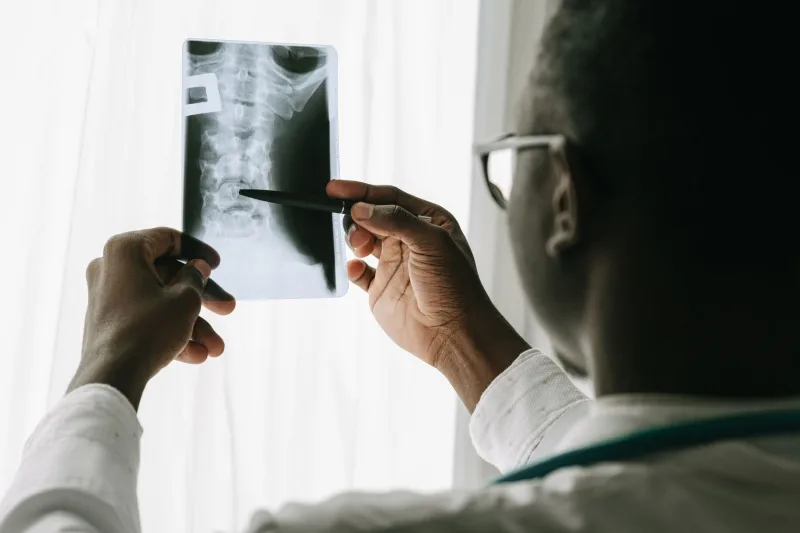
Disc degeneration is the loss of water and thinning of the discs between the vertebrae with age. The meaning of loss of curvature and arthritis in MRI reports is explained.
What is disc degeneration?
Between the vertebrae there are discs that act as cushions. In the middle of the disc is a jelly-like core, surrounded by a tougher ring. The discs give the spine flexibility and spread the load.
With age, the discs lose water. They become less flexible and lose height. Small tears may form in the outer ring of the disc. This process is called disc degeneration or disc wear. It is most common in the lower back and neck.
Disc wear is largely a natural part of ageing. It is particularly common after the age of 40. In many people, it causes no symptoms at all.
What does spinal arthritis mean?
As a disc becomes thinner, the distribution of load between the vertebrae changes. In response to the increased load, bony spurs form at the edges of the vertebrae. These are called osteophytes. The small joints at the back of the vertebrae (the facet joints) also wear, and the joint space narrows.
This is what is commonly called arthritis of the spine and, in medical terms, spondylosis. Spinal arthritis does not always cause pain. However, symptoms may appear if the bony spurs press on the nerve roots or the spinal cord.
What does loss of neck or lower back curvature mean?
In a healthy spine, the neck and lower back have a slight inward curve. This is called lordosis. The phrases "loss of cervical lordosis" or "loss of lumbar lordosis", which are common in X-ray or MRI reports, describe a reduction in this curve.
Loss of curvature on its own is not the name of a disease. A large analysis of people without symptoms found that about a third of them had a straight neck or a neck with a different curvature. The same study found no clear difference in neck curvature between people with and without complaints. Advanced disc wear can also affect the alignment of the spine. For this reason, the phrase in the report is interpreted together with your complaints and examination findings. The same approach applies to loss of lower back curvature.
Disc degeneration, loss of curvature and arthritis: symptoms
Disc wear and spinal arthritis often cause no symptoms. When they do, the following may be seen:
- Pain and stiffness in the lower back or neck that come and go during the day
- A headache spreading from the neck to the back of the head
- If there is nerve root compression, pain, numbness and weakness spreading to an arm or leg
- If there is spinal cord compression in the neck, clumsy hands and unsteadiness when walking
Disc degeneration, loss of curvature and arthritis: how is it diagnosed?
First, your complaints are listened to and an examination is performed. Muscle strength, reflexes and sensation are assessed. If necessary, an X-ray, MRI or CT is requested.
An important point is this: signs of wear seen on MRI are not always the source of the complaint. Many people without symptoms also have similar findings. For this reason, imaging results are matched with the examination findings.
Disc degeneration, loss of curvature and arthritis: treatment options
Non-surgical treatment
In most patients, treatment is non-surgical. Gentle exercises, improving posture and regular movement are the first steps. Painkillers and anti-inflammatory medicines and, if necessary, muscle relaxants may be used for pain. If the complaint does not go away within a few weeks, physiotherapy may be recommended. Exercises that strengthen the core muscles support the health of the lower back.
Interventional pain treatments
If the pain continues, procedures such as an epidural injection, a facet joint injection or the radiofrequency method may be considered. These procedures are chosen according to the source of the pain.
Surgical treatment
Surgery is considered only if there is pressure on a nerve root or the spinal cord and there is no response to other treatments. Decompression is performed to relieve the pressure. If necessary, the vertebrae are joined together (fusion). Surgery does not always remove all the complaints; however, it can help to stop the symptoms getting worse. Possible risks are discussed in detail with your doctor before surgery.
Tips for daily life
- Stay active; do gentle, regular exercise.
- Pay attention to your posture when sitting and working.
- Do the gentle movement exercises recommended for the neck regularly.
- Support your lower back with exercises that strengthen the core muscles.
- Use painkillers at the recommended dose and for the recommended length of time.
Disc degeneration, loss of curvature and arthritis: frequently asked questions
My report says "loss of lordosis" and "degeneration". Is it serious?
These phrases are very common and most of the time describe age-related changes. What matters are your complaints and your examination findings. Go through the report with your doctor.
Does spinal arthritis need surgery?
Most of the time, no. Surgery is considered when there are marked complaints caused by pressure on a nerve or the spinal cord.
Does exercise wear the discs down further?
Gentle exercises and improving posture are among the first methods recommended. Adjust movements that markedly increase the pain together with your doctor or physiotherapist.
Disc degeneration, loss of curvature and arthritis: when should you seek care?
A specialist examination is needed if your lower back or neck pain does not ease within a few weeks, if it spreads to an arm or leg, or if it is accompanied by numbness.
Go to the nearest emergency department in the case of sudden, severe pain together with loss of strength in an arm or leg, difficulty walking, or impaired bladder or bowel control.
Disc degeneration, loss of curvature and arthritis: what happens at the consultation?
You will be asked where your pain is, how long you have had it and what makes it worse. Muscle strength, sensation and reflexes are examined. Any X-ray and MRI images are reviewed together with their reports. The treatment options suitable for you are then explained.
The information on this page is for general information only; an examination is needed for a diagnosis and treatment decision. Every patient's situation is unique.