

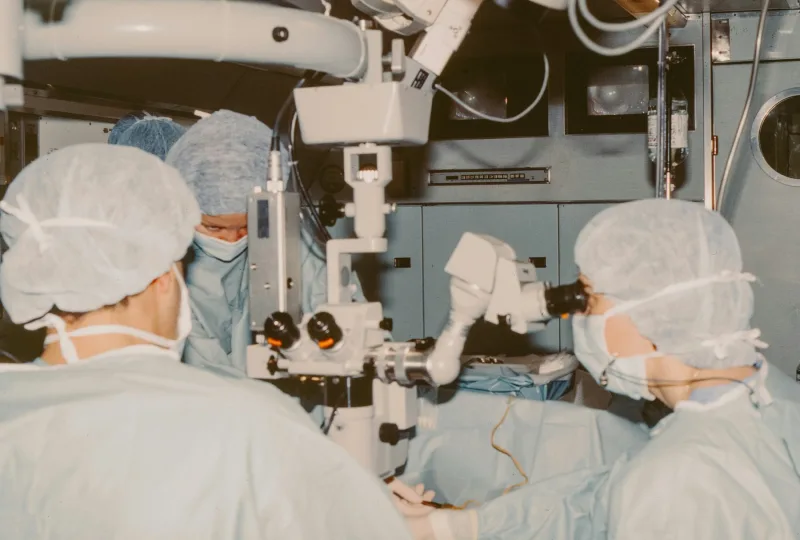
An operation in which the disc fragment causing pain that radiates into the leg is removed through a small incision with the help of a microscope, relieving pressure on the nerve.
What is microsurgical lumbar disc surgery (lumbar microdiscectomy)?
In a lumbar disc herniation, part of the disc between the vertebrae can press on a nerve root and cause nerve pain radiating into the leg (sciatica). Microdiscectomy is the removal of the disc fragment that is pressing on the nerve. Because the operation is performed with magnifying instruments such as an operating microscope, usually through a small incision of a few centimetres, it is described as “minimally invasive” or “microsurgical”.
In a large proportion of people who see a doctor for sciatica for the first time, the complaints ease within a few weeks, either on their own or with treatment; for this reason, surgery is often not the first option. Surgery is considered when the complaints do not improve sufficiently or when neurological findings appear. The operation is more effective for leg pain than for low back pain; numbness and weakness may persist for some time after surgery.
This page is for general information only and does not replace diagnosis or treatment. Whether the procedure is suitable for you can only be decided on the basis of your examination and imaging findings.
When is it considered?
Your doctor may consider surgery in the following situations:
- Leg pain that is severe or markedly limits daily life and still persists after weeks despite medication, physiotherapy and, where appropriate, injections.
- Imaging shows a herniation pressing on the nerve that is consistent with the symptoms and examination findings.
- Increasing neurological findings, such as weakness in the foot.
- Emergencies such as cauda equina syndrome (loss of bladder or bowel control, numbness in the groin).
Preparing for the procedure
- A pre-operative examination, blood tests, a heart and lung assessment if needed and a consultation with the anaesthetist are carried out.
- Your doctor will decide how blood thinners, aspirin, herbal products and your diabetes, blood pressure and heart medicines should be used; do not stop or start anything on your own.
- Smoking and alcohol have a negative effect on healing; stopping before and after surgery is recommended.
- You will need to fast for a set period before surgery (no eating or drinking); follow the instructions given.
- Bring your existing MRI, CT and X-ray images and your list of medicines; tell the team about any allergies.
How is the operation performed?
- The operation is usually performed under general anaesthesia; you are positioned face down or on your side.
- The correct level is confirmed with X-ray during the operation.
- A small incision is made in the middle of the lower back; the muscles are separated from the bone and moved aside.
- With the help of the microscope, a small piece of the bone and ligament covering the herniation is removed (this is called a laminotomy), giving access to the nerve root.
- The nerve is gently moved aside, the disc fragment pressing on it is removed and it is confirmed that the nerve has been freed.
- The incision is closed in layers; sometimes a small drain may be placed.
In some patients, depending on the location and type of the herniation, a wider decompression (laminectomy) or an endoscopic method may be preferred; which technique is suitable is decided on the basis of your imaging findings.
After the procedure: recovery, discharge and activity
A short hospital stay is usually sufficient after surgery; one night for most patients, slightly longer for some. Getting up and walking are usually encouraged shortly after the operation. Pain is controlled with painkillers. Before discharge, wound care, use of medicines, warning signs and your follow-up appointment are explained to you both in writing and verbally.
At home, walking is allowed in the first weeks; follow your doctor's advice on heavy lifting, bending forward, prolonged sitting and driving. The wound is kept dry, and the stitches are removed at the time set by your doctor. In the following weeks, exercises to strengthen the back and abdominal muscles can be started. When you return to work and normal life varies from person to person, depending on the nature of your work and your recovery.
Sciatic pain usually eases after surgery; however, recovery from numbness and weakness can take time and may not be complete in every patient.
Microsurgical lumbar disc surgery: alternatives
If the symptoms are under control, monitoring without surgery may be the best option. Alternatives include medication, physiotherapy, epidural or foraminal injection, minimally invasive procedures such as nucleoplasty, and endoscopic discectomy. Which option is suitable for you is decided on the basis of examination and imaging.
Questions you may want to ask your doctor
- What is the aim of the operation, which of my complaints are expected to improve and which may persist?
- What would postponing surgery or monitoring without surgery mean in my case?
- Which technique is planned and why? What are the alternative techniques?
- How long will I stay in hospital, and how will home care and follow-up work?
- When can I return to work, driving and sport?
Microsurgical lumbar disc surgery: possible risks
Every procedure has possible risks and alternatives; these vary from person to person and are discussed in detail with your doctor beforehand. The main points are:
- Anaesthesia risks: General anaesthesia carries risks such as heart, lung and allergic problems; an anaesthetist assesses you before the operation.
- Infection: This can develop at the wound or deeper; it may require antibiotics, wound care and, rarely, another operation.
- Bleeding: This may occur during or after the operation; rarely, additional treatment or a blood transfusion is needed.
- Possibility of nerve injury: Because the work is done close to nerve tissue, numbness, weakness or increased pain may occur; this is usually temporary and rarely permanent.
- Cerebrospinal fluid leak: This can occur if the membrane covering the nerves is torn; it is usually treated within a few days.
- Persistent symptoms or recurrence: Pain, numbness or weakness may continue after surgery or reappear over time.
- Re-herniation at the same level: There is a possibility of recurrence; rarely, a second operation may be needed.
- Bleeding and vascular injury: Very rarely, damage to the large blood vessels in front of the spine has been reported.
Conditions such as smoking, diabetes, high blood pressure, excess weight and heart disease can increase the risks, so it is important to give your doctor a complete account of your medicines, allergies and medical history.
What happens at the consultation? When should you seek care?
At the consultation, the course of the pain, a neurological examination (strength, sensation, reflexes) and MRI findings are evaluated together. This assessment determines whether surgery is needed, when it should be done and what the alternatives are.
Go to the nearest emergency department without delay in the following situations: rapidly increasing weakness in the legs or arms, inability to control urine or stool, numbness in the groin and between the legs, or severe back pain accompanied by fever.