

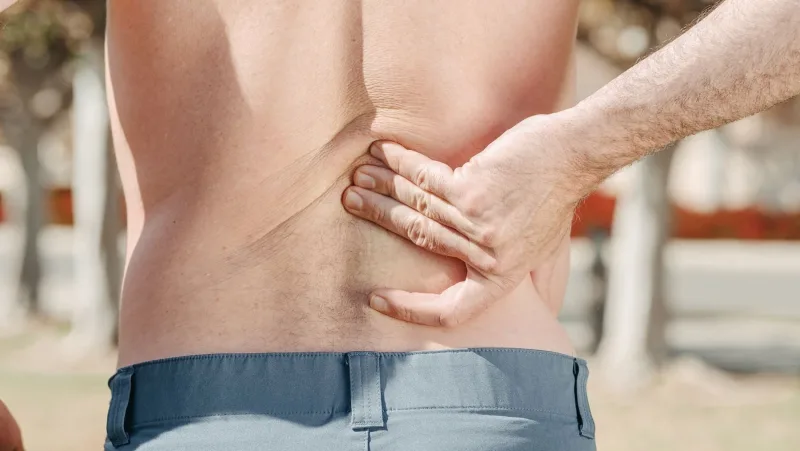
Cauda equina syndrome is severe compression of the nerve roots in the lower back. Numbness around the bottom and bladder or bowel problems need urgent assessment.
What is cauda equina syndrome?
The spinal cord ends in the upper part of the lower back. Below this point, the nerve roots travel down inside the spinal canal as a bundle. Because this bundle resembles a horse's tail, it is called the cauda equina (Latin for "horse's tail").
These nerves control movement and sensation in the legs. They also control the bladder, the bowel and sexual function.
Cauda equina syndrome is when several of these nerve roots are compressed and cannot work properly. It is rare, but it is an emergency. Early treatment helps to reduce the risk of permanent nerve damage.
Who gets it?
Cauda equina syndrome is rare. It mostly affects adults of working age. Because its most common cause is a herniated disc, it is important for people diagnosed with a herniated disc or sciatica to know the warning signs.
What causes it?
The most common cause is a large herniated disc in the lower back. The herniated piece of disc spills into the canal and compresses the nerve roots.
Other causes include:
- Narrowing of the spinal canal
- Spinal and spinal cord tumours
- Spinal infections and abscesses
- Spinal fractures and trauma
- Complications such as bleeding after lower back surgery
Symptoms: recognise these signs
- Pain spreading to both legs, or severe low back pain
- Numbness or tingling between the legs, around the genitals, the bottom and the buttocks (saddle numbness)
- A change in sensation when using toilet paper
- Difficulty passing urine, or difficulty starting or stopping the flow
- Urinary incontinence or not being able to feel that the bladder is full
- Bowel incontinence or not being able to notice the urge to open the bowels
- Increasing weakness in both legs, and difficulty lifting the foot
- New sexual dysfunction
Symptoms may start suddenly. Sometimes they develop gradually over days. In someone with a herniated disc or sciatica, a new appearance of any of these symptoms is a warning sign.
Cauda equina syndrome: how is it diagnosed?
During the examination, muscle strength and reflexes in the legs and sensation around the bottom are checked.
An emergency MRI is done to confirm the diagnosis. MRI shows the cause and location of the nerve compression. When MRI cannot be done, other imaging such as CT or myelography is used. The examination alone does not confirm the diagnosis. This is why rapid imaging is important.
Cauda equina syndrome: treatment options
Once the diagnosis is confirmed, treatment is usually emergency surgery. The aim is to relieve the nerves by removing the piece of disc, bone or other tissue pressing on the nerve roots. This procedure is called decompression.
When it is caused by a herniated disc, the back part of the bone covering the herniation is removed (laminectomy). The herniated piece of disc is then removed with the help of a microscope, and the nerve canals are relieved.
The surgery is performed as soon as possible. Sources report that surgery done within the first 48 hours after symptoms begin offers a clear advantage for the recovery of sensation and muscle strength. When the cause is a tumour or an infection, treatments targeting the cause are also planned in addition to surgery.
After surgery and risks
Recovery varies from person to person. Leg strength, sensation, and bladder and bowel function may improve over time. This improvement may take months or even years. In some patients, loss of sensation or bladder and bowel problems may be permanent.
During this process, support may be needed with physiotherapy and with bladder and bowel care. Surgical risks such as bleeding, infection, nerve injury and fluid leakage from a tear in the membrane covering the spinal cord are explained in detail to you and your family before surgery.
Cauda equina syndrome: frequently asked questions
Does everyone with a herniated disc develop cauda equina syndrome?
No. Herniated discs are common, whereas cauda equina syndrome is rare. Even so, it is important for everyone with a herniated disc to know the warning signs.
If the symptoms start at night or at the weekend, should I wait?
No. These symptoms should be assessed without waiting for an appointment, whatever the time of day.
Will my complaints go away completely after surgery?
This depends on the severity of the symptoms and how early treatment is started. The longer treatment is delayed, the greater the risk of permanent weakness and problems with bladder and bowel control. Improvement can continue for a long time after surgery.
Cauda equina syndrome: when should you seek care?
If any of the following symptoms has started recently, go to the nearest emergency department without waiting for an appointment: numbness around the bottom, groin or genitals; being unable to pass urine or urinary incontinence; bowel incontinence; pain in both legs at once or increasing weakness.
When you go to the emergency department, say when the symptoms started and mention any history of a herniated disc or lower back surgery. Take your previous MRI reports and a list of the medicines you take with you. Do not wait for the symptoms to go away on their own.
If you have low back or leg pain but none of these warning signs, and your pain does not ease within a few weeks, arrange a specialist examination.
Cauda equina syndrome: what happens at the consultation?
You will be asked when the symptoms started and how they have progressed. Leg strength, reflexes and sensation around the bottom are checked. An MRI is arranged quickly. An examination around the bottom may also be needed to understand the condition of the nerves. If the diagnosis is confirmed, the treatment options and risks are explained to you and your family. Feel free to share your questions and concerns.
The information on this page is for general information only; an examination is needed for a diagnosis and treatment decision. Every patient's situation is unique.