

Lumbar spinal stenosis compresses the nerves and causes leg pain that worsens when walking and eases when sitting. Symptoms and treatment options.
What is spinal stenosis?
The vertebrae are stacked on top of each other to form a canal through which the nerves pass. When this canal narrows over time and presses on the nerves, it is called narrowing of the spinal canal. Its medical name is spinal stenosis; in the lower back it is called lumbar spinal stenosis, and in everyday language it is also described as a narrow canal or canal narrowing. The most common form, and the one that causes the most complaints, is narrowing of the canal in the lower back; this page mainly covers the lower back.
It is sometimes popularly called “narrowing of the spinal cord canal”. However, the spinal cord ends in the upper part of the lumbar spine; inside the canal in the lower back there is not the spinal cord but the nerve roots going to the legs. For this reason, the structure compressed in the lower back is not the spinal cord but these nerve roots.
Narrowing can also occur in the neck (cervical stenosis). Because the spinal cord lies inside the canal in the neck, the picture is different: symptoms such as clumsiness of the hands, difficulty with fine tasks and unsteadiness when walking may come to the fore. This condition is described separately on the cervical myelopathy page.
Why does it happen?
The most common cause of lumbar spinal stenosis is age-related wear (degeneration). Over time the discs lose height and can bulge into the canal; the small joints between the vertebrae (facet joints) thicken, bone spurs form and the ligament on the back wall of the canal thickens. These changes develop slowly over the years. For this reason, spinal stenosis is mostly seen in older age, especially at 60 and over.
In some people the canal is narrow from birth. Spondylolisthesis, in which one vertebra slips forward over the one below, a sideways curvature of the spine (degenerative scoliosis), previous spinal surgery or fractures can also contribute to the narrowing.
Symptoms of spinal stenosis
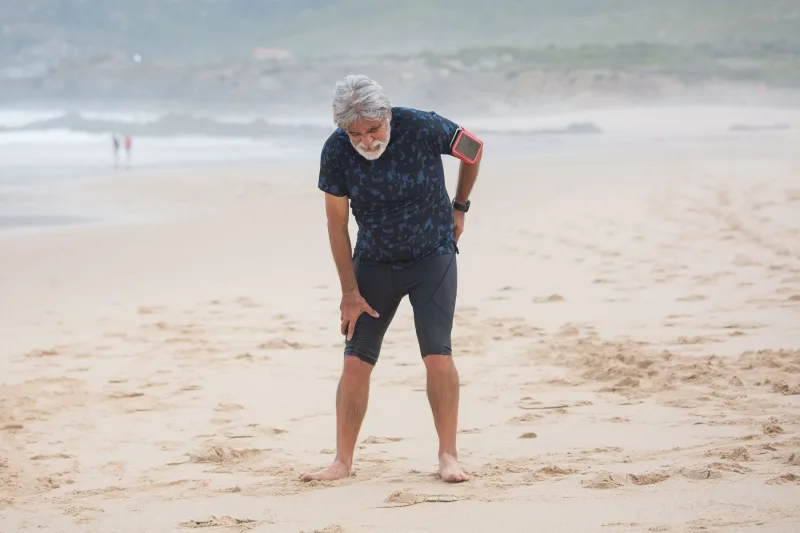
The most typical symptom of lumbar spinal stenosis is pain, numbness, tingling or a feeling of heaviness in the legs that appears when walking or standing for a long time. After walking for a while, the person has to stop, sit down or bend forward; the complaints ease when sitting or bending forward. In medicine this picture is called neurogenic claudication (limping caused by the nerves).
- Pain or numbness spreading from the buttocks into the legs that increases with walking
- A walking distance that gets progressively shorter
- Relief when bending forward, sitting or lying down; feeling more comfortable when walking while leaning on a shopping trolley
- Low back pain (not always present)
- In advanced cases, weakness in the legs
Bending forward widens the canal slightly, while standing upright and leaning backwards narrows it. This is why relief comes with bending forward. Not every case of low back pain is caused by spinal stenosis; also, not everyone in whom narrowing is seen on MRI has complaints.
How it differs from vascular claudication
Leg pain when walking can also be caused by narrowing of the leg arteries (peripheral arterial disease). Pain of vascular origin is usually felt in the calf and goes away after stopping and resting on the spot for a few minutes. In spinal stenosis, however, the pain can also start just from standing, and relief often requires sitting down or bending forward. It is not always easy to tell these two apart by looking at a single symptom; during the examination the pulses in the feet and behind the knees are checked and, if necessary, the arteries are examined with ultrasound (Doppler).
The difference between spinal stenosis and a herniated disc
A herniated disc occurs when the inner part of a disc between the vertebrae bulges out and usually compresses a single nerve root. It is seen more often in people in their 30s and 40s and usually shows itself as sciatica, pain in one leg that spreads along the path of a specific nerve.
Spinal stenosis, on the other hand, is a narrowing that develops over the years and affects the whole canal or part of it. It is seen at an older age, often affects both legs, and the complaints clearly depend on walking, standing and posture. The two conditions can also exist together: a bulging disc can further narrow a canal that is already narrow. Which one is causing the complaints is decided by looking at the examination findings together with the imaging.
Lumbar spinal stenosis: how is it diagnosed?
The basis of the diagnosis is listening to the complaints and a neurological examination: walking distance, relieving positions, muscle strength, reflexes and sensation are assessed. The narrowing of the canal and its effect on the nerves are shown by MRI; CT may be requested to see the bone structure in detail or when MRI cannot be performed. Dynamic X-rays taken while bending forward and backward can be used to see whether there is slippage or instability in the spine.
The degree of narrowing on MRI and the severity of the complaints do not always go hand in hand. In this video, Op. Dr. Hasan Kanyılmaz also explains that decisions about low back pain should not be made by looking only at the MRI image, and that the patient is first listened to and examined.
Can spinal stenosis improve without surgery?
Because spinal stenosis is a structural change, the canal does not widen on its own. However, in most patients the complaints can be brought under control with non-surgical methods, and studies have found that the long-term results of non-surgical and surgical treatment are close to each other. For mild and moderate complaints, the first step is usually non-surgical treatment:
- Exercise and physiotherapy: Movements focused on bending forward (flexion), strengthening the hip and leg muscles, and posture training. Activities that do not strain the joints, such as swimming or a stationary bike, are often better tolerated than walking.
- Medication: Painkillers and anti-inflammatory medicines and, if necessary, medicines for nerve pain.
- Lifestyle adjustments: Weight control, stopping smoking, adjusting activity according to the complaints; short-term use of a back brace.
- Epidural injection: In selected patients with marked pain spreading to the leg, an epidural steroid injection, in which medication is delivered close to the nerve root under image guidance, may be performed. Relief is usually short-lived, and studies have found its long-term effect in spinal stenosis to be limited; who may benefit is assessed through examination.
In scientific reviews, the most consistent evidence among non-surgical methods is for programmes that combine exercise and manual physiotherapy.
When is surgery needed for spinal stenosis?
Surgery is generally considered in the following situations:
- Leg pain and limited walking that markedly affect daily life despite appropriate non-surgical treatment (usually for 2–3 months)
- Progressive weakness or loss of sensation in the legs
- Bladder or bowel control is affected; in this case surgery is planned without waiting
The aim of surgery is to relieve pressure on the nerves (decompression). The thickened ligament and bone tissue narrowing the canal are removed under the microscope, taking care to preserve the stability of the spine. The details are described on the lumbar spinal stenosis decompression surgery page.
Not every spinal stenosis operation requires fixation with screws (fusion). Fusion is added to decompression in situations where the stability of the spine is impaired, such as spondylolisthesis, marked curvature or abnormal movement (instability) of the spine. Which method is suitable is determined by the level and number of narrowed segments, the alignment of the spine and your general health.
Surgery is performed more for leg pain and walking distance than for low back pain. Numbness and weakness may improve later or only partially after surgery.
Lumbar spinal stenosis: when should you seek care?
A specialist examination is needed if you notice pain or numbness in your legs that increases when walking, a walking distance that keeps getting shorter, or weakness in your legs.
Go to the nearest emergency department if you are unable to pass urine, have urinary or bowel incontinence, numbness around the groin and genitals, or rapidly increasing weakness in your legs. These symptoms may be a sign of an emergency such as cauda equina syndrome.
Lumbar spinal stenosis: what happens at the consultation?
You will be asked about your complaints, how far you can walk and in which positions you feel relief, and a neurological examination is performed. Bringing any previous MRI and CT images and reports, the medicines you use and details of any physiotherapy or injection treatments you have had makes the assessment easier. Non-surgical and surgical options are then discussed together with their possible benefits and risks.
Lumbar spinal stenosis: frequently asked questions
Is spinal stenosis surgery risky?
As with every operation, spinal stenosis surgery has risks; these include infection, bleeding, fluid leakage due to a tear in the nerve membrane and nerve injury. Serious problems are uncommon. The risks vary from person to person depending on age, other illnesses and the extent of the procedure; preparations such as stopping smoking, keeping blood sugar under control and arranging blood-thinning medicines with the doctor in advance help reduce the risks. Possible risks are discussed in detail with your doctor before surgery.
Which doctor should I see for spinal stenosis?
Lumbar spinal stenosis is assessed and treated by neurosurgeons (specialists in brain and nerve surgery); orthopaedic surgeons who specialise in the spine also treat these patients. During non-surgical treatment, care may be shared with physical medicine and rehabilitation doctors.
Is exercise good for a narrow spinal canal?
Yes, exercise is one of the most important parts of non-surgical treatment. Movements focused on bending forward, such as pulling the knees to the chest, exercises that strengthen the hip and leg muscles, and activities such as swimming or a stationary bike are generally beneficial. If a movement clearly increases the pain and the pain does not settle, it should be stopped and a doctor or physiotherapist consulted.
Does a narrow canal on MRI mean that I need surgery?
No. The narrowing on the image and the complaints do not always go hand in hand, and many people with narrowing may have no complaints at all. The decision is determined as much by your complaints and examination findings as by the image.
Can spinal stenosis cause paralysis?
Lumbar spinal stenosis usually progresses slowly. Because there is no spinal cord in the lower back, spinal cord paralysis is not expected; however, if the nerve roots are compressed for a long time, weakness and loss of sensation in the legs can develop. Symptoms such as loss of bladder or bowel control require urgent assessment.
The information on this page is for general information only; an examination is needed for a diagnosis and treatment decision. Every patient's situation is unique.
Lumbar spinal stenosis: sources
- Kwon JW et al. Lumbar Spinal Stenosis: Review Update 2022. Asian Spine J, 2022 (PMC)
- AANS: Lumbar Spinal Stenosis
- AANS: Cauda Equina Syndrome
- Nadeau M et al. The reliability of differentiating neurogenic claudication from vascular claudication based on symptomatic presentation. Can J Surg, 2013 (PubMed)
- Ammendolia C et al. Non-operative treatment for lumbar spinal stenosis with neurogenic claudication: an updated systematic review. BMJ Open, 2022 (PubMed)
- Leeds Community Healthcare NHS Trust: Spinal stenosis
- NHS: Peripheral arterial disease (PAD)