

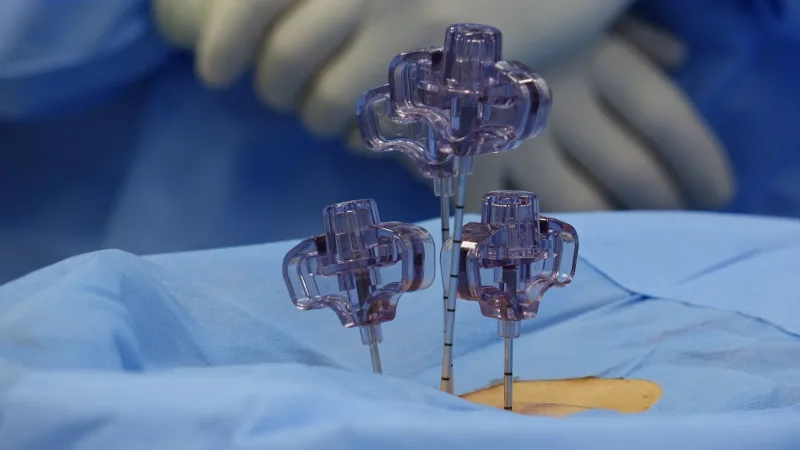
Procedures in which bone cement is injected into a collapsed vertebra through a thin needle, aiming to support the vertebra and reduce pain.
What are vertebroplasty and kyphoplasty?
Vertebrae can lose height and collapse because of bone loss (osteoporosis), a tumour or an injury. This can cause pain in the back and, over time, a forward-stooped posture.
In vertebroplasty, the collapsed vertebra is entered with a thick needle and bone cement is injected through it. In kyphoplasty, a small balloon is first placed inside the vertebra through the needle and inflated to create a cavity, which is then filled with cement; the aim is to support the vertebra and restore some of its height. If considered necessary, a biopsy (tissue sample) can also be taken during the same procedure.
There is scientific debate about the role, patient selection and effectiveness of these procedures; Cochrane reviews recommend caution regarding the routine use of vertebroplasty. Identifying the right patient is therefore very important.
This page is for general information only and does not replace diagnosis or treatment. Whether the procedure is suitable for you can only be decided on the basis of your examination and imaging findings.
When is it considered?
Your doctor may consider the procedure in the following situations:
- Imaging shows a recent vertebral compression fracture, and the pain is consistent with it.
- Marked pain that continues despite measures such as medication, rest and a brace.
- Support is considered necessary for an area of the vertebra weakened or affected by a tumour (in some cases together with a biopsy).
Preparing for the procedure
- Bring your MRI, CT and, if available, bone density results; the imaging may need to be reviewed again before the procedure.
- Provide information about your blood-thinning medicines, allergies and chronic illnesses; any medication changes are made by the doctor.
- Report any signs of infection (fever, urinary tract infection, cough) in advance.
- The procedure can be performed under local or general anaesthesia; fasting instructions will be given by the team.
- Have someone accompany you on the day of the procedure.
How is the procedure performed?
- The procedure is carried out in an operating room under sterile conditions with continuous X-ray (fluoroscopy) guidance; local or general anaesthesia is used.
- You lie face down; the skin is cleaned and draped.
- A special needle (cannula) is advanced into the collapsed vertebra through a very small cut in the skin.
- In kyphoplasty, the balloon is inflated and removed; the prepared bone cement is then injected in a controlled way.
- The cement hardens quickly; the needle is removed and the small incision is closed.
Rarely, if the needle route is not suitable because of the location of the tumour or fracture, the cement can be delivered through small open surgery under a microscope; in some cases additional stabilisation, such as screws and rods, may also be needed. The doctor decides on these details before the procedure and informs you.
After the procedure: recovery, discharge and activity
After the procedure you are observed lying down for a while; most people are discharged the same day or the next day. When to get up and whether a brace is needed are decided by your doctor.
The procedure site may be tender for a few days. Heavy lifting and strenuous movements are avoided for a while; you then return to activity with walking and light exercise. Where osteoporosis is present, treatment for bone health and measures to prevent falls are planned separately to reduce the risk of new fractures.
Vertebroplasty and kyphoplasty: alternatives
The main alternatives are painkillers, rest, a brace, treatment for bone loss and physiotherapy. If there is a tumour or instability, surgical stabilisation with screws and rods or methods such as radiotherapy may be needed; in these situations the treatment options are decided together with your doctor.
Questions you may want to ask your doctor
- What is the aim of the procedure, which of my complaints are expected to improve and which may persist?
- What would postponing the procedure or monitoring without it mean in my case?
- Which technique is planned and why? What are the alternative techniques?
- How long will I stay in hospital, and how will home care and follow-up work?
- When can I return to work, driving and sport?
Vertebroplasty and kyphoplasty: possible risks
Every procedure has possible risks and alternatives; these vary from person to person and are discussed in detail with your doctor beforehand. The main points are:
- Anaesthesia risks: General anaesthesia carries risks such as heart, lung and allergic problems; an anaesthetist assesses you before the procedure.
- Infection: This can develop at the wound or deeper; it may require antibiotics, wound care and, rarely, another operation.
- Bleeding: This may occur during or after the procedure; rarely, additional treatment or a blood transfusion is needed.
- Possibility of nerve injury: Because the work is done close to nerve tissue, numbness, weakness or increased pain may occur; this is usually temporary and rarely permanent.
- Cerebrospinal fluid leak: This can occur if the membrane covering the nerves is torn; it is usually treated within a few days.
- Persistent symptoms or recurrence: Pain, numbness or weakness may continue after the procedure or reappear over time.
- Cement leakage: If cement leaks outside the vertebra, it can press on a nerve root or the spinal cord; although rare, this can cause temporary or permanent nerve damage.
- Embolism to the lungs: Very rarely, cement or fat particles can travel through the bloodstream to the lungs.
- New fractures in adjacent vertebrae: This can occur particularly in people with bone loss.
Conditions such as smoking, diabetes, high blood pressure, excess weight and heart disease can increase the risks, so it is important to give your doctor a complete account of your medicines, allergies and medical history.
What happens at the consultation? When should you seek care?
At the consultation, the location and character of your pain, your neurological findings and your imaging are evaluated. The age and cause of the fracture and the suitability of the procedure for you are determined through this assessment.
Go to the nearest emergency department without delay in the following situations: rapidly increasing weakness in the legs or arms, inability to control urine or stool, numbness in the groin and between the legs, or severe back pain accompanied by fever.