

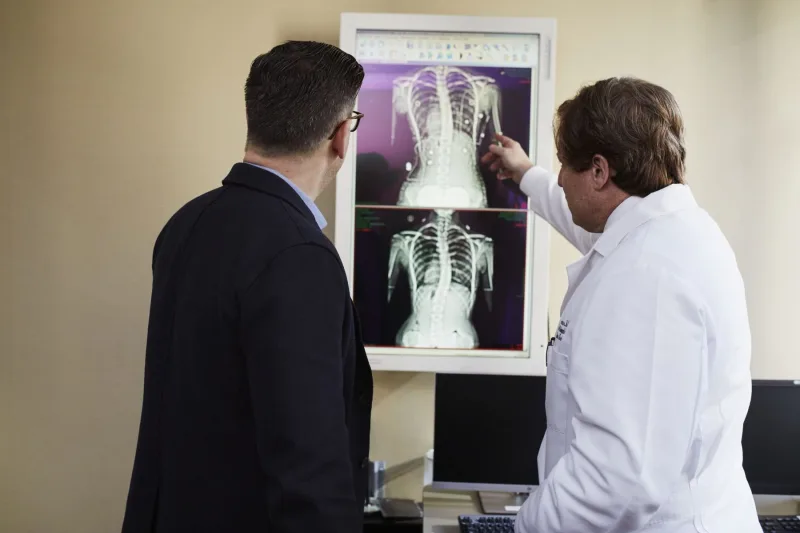
The surgical removal or sampling of tumours arising from the spinal cord, its membranes or the vertebral bones, with the aim of relieving pressure on the spinal cord.
What is spinal and spinal cord tumour surgery?
Spinal and spinal cord tumours can arise from the spinal cord tissue, the membranes surrounding the spinal cord, the nerve roots or the bones that make up the spine, or they may have spread from another organ. They are described in three groups according to their location: extradural (outside the membrane), intradural extramedullary (inside the membrane but outside the spinal cord) and intramedullary (inside the spinal cord).
A tumour can press on the spinal cord or nerves and cause pain, numbness, weakness and problems with bladder and bowel control. The aim of surgery is to remove the tumour as safely as possible or take a sample for diagnosis (biopsy), relieve pressure on the spinal cord, preserve nerve function and, if necessary, stabilise the spine. Whether the tumour can be removed completely depends on its location and type and cannot be guaranteed in advance.
This page is for general information only and does not replace diagnosis or treatment. Whether the procedure is suitable for you can only be decided on the basis of your examination and imaging findings.
When is it considered?
The decision to operate is made according to the type and location of the tumour and your general health; the following situations may lead to it being considered:
- Signs of pressure on the spinal cord or nerves appear.
- A tissue sample is needed to confirm the diagnosis.
- There is a risk that the tumour will make the spine unstable, or the pain cannot be controlled.
- Depending on the tumour type, surgery is planned together with radiotherapy and other treatments.
Preparing for the procedure
- A pre-operative examination, blood tests, a heart and lung assessment if needed and a consultation with the anaesthetist are carried out.
- Your doctor will decide how blood thinners, aspirin, herbal products and your diabetes, blood pressure and heart medicines should be used; do not stop or start anything on your own.
- Smoking and alcohol have a negative effect on healing; stopping before and after surgery is recommended.
- You will need to fast for a set period before surgery (no eating or drinking); follow the instructions given.
- Bring your existing MRI, CT and X-ray images and your list of medicines; tell the team about any allergies.
- Before surgery, MRI and, where necessary, additional imaging such as CT or angiography are performed.
- During surgery, special monitoring of spinal cord and nerve function (neuromonitoring) may be used.
How is the operation performed?
- Under general anaesthesia you usually lie face down.
- An incision is made over the back of the neck, upper back or lower back at the level of the tumour; the muscles are moved aside.
- To reach the spinal canal, part of the bone is removed (laminectomy or hemilaminectomy); sometimes the bone piece is put back at the end of the operation.
- If necessary, the membrane surrounding the spinal cord (dura) is opened and the tumour is removed or sampled under the microscope, taking care not to damage the nerve tissue.
- The membrane is closed tightly; if necessary, the spine is stabilised with screws and rods; the incision is closed in layers.
The removed tissue is sent to pathology; the type of tumour becomes clear with the final result. Whether further treatment is needed is discussed on the basis of this result.
After the procedure: recovery, discharge and activity
After surgery, monitoring takes place in intensive care or on the ward. Pain control, early mobilisation and, where necessary, physiotherapy are started. The hospital stay can vary from a few days to longer, depending on the extent of the operation. Before discharge, wound care, use of medicines, warning signs and your follow-up appointment are explained to you both in writing and verbally.
Wound care continues at home; the stitches are removed at the time set by the doctor. Heavy lifting and strenuous movements are limited for a while. Rehabilitation is planned to help regain strength and balance. Depending on the pathology result, you may be referred to specialist teams for radiotherapy or other treatments. Follow-up MRI scans are scheduled at regular intervals.
Spinal and spinal cord tumour surgery: alternatives
For some tumours, radiotherapy, radiosurgery, drug treatments or close monitoring are options instead of or together with surgery. If there is destruction of the spine or instability, cement procedures (vertebroplasty) or screw-and-rod systems may be considered. The treatment plan is often decided jointly by several specialties.
Questions you may want to ask your doctor
- What is the aim of the operation, which of my complaints are expected to improve and which may persist?
- What would postponing surgery or monitoring without surgery mean in my case?
- Which technique is planned and why? What are the alternative techniques?
- How long will I stay in hospital, and how will home care and follow-up work?
- When can I return to work, driving and sport?
Spinal and spinal cord tumour surgery: possible risks
Every procedure has possible risks and alternatives; these vary from person to person and are discussed in detail with your doctor beforehand. The main points are:
- Anaesthesia risks: General anaesthesia carries risks such as heart, lung and allergic problems; an anaesthetist assesses you before the operation.
- Infection: This can develop at the wound or deeper; it may require antibiotics, wound care and, rarely, another operation.
- Bleeding: This may occur during or after the operation; rarely, additional treatment or a blood transfusion is needed.
- Possibility of nerve injury: Because the work is done close to nerve tissue, numbness, weakness or increased pain may occur; this is usually temporary and rarely permanent.
- Cerebrospinal fluid leak: This can occur if the membrane covering the nerves is torn; it is usually treated within a few days.
- Persistent symptoms or recurrence: Pain, numbness or weakness may continue after surgery or reappear over time.
- Possible worsening of spinal cord and nerve function: Weakness, loss of sensation or impaired bladder and bowel control may occur; the risk varies with the location of the tumour.
- Incomplete removal of the tumour and recurrence: The tumour may grow again over time; further treatment may be needed.
Conditions such as smoking, diabetes, high blood pressure, excess weight and heart disease can increase the risks, so it is important to give your doctor a complete account of your medicines, allergies and medical history.
What happens at the consultation? When should you seek care?
At the consultation, your neurological findings and your MRI and other imaging are evaluated together; if necessary, a joint assessment is made with other relevant specialties. This assessment determines whether surgery is needed, its timing and the alternatives.
Go to the nearest emergency department without delay in the following situations: rapidly increasing weakness in the legs or arms, inability to control urine or stool, inability to walk, or severe back pain that becomes markedly worse at night.