

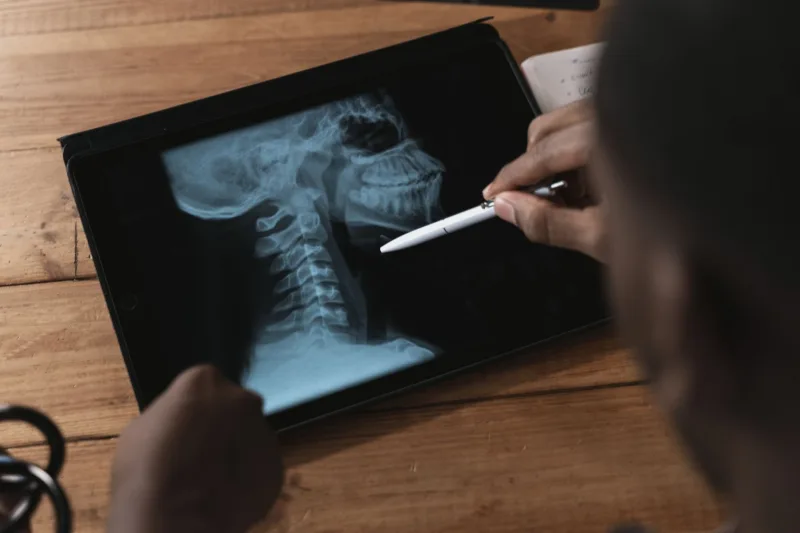
Loss of cervical lordosis is a reduction in the natural curve of the neck vertebrae. Most of the time it is not dangerous; we explain what it means and when it matters.
Loss of cervical lordosis is the reduction or disappearance of the curve of the neck vertebrae, which normally curves slightly forwards. In medicine, this is called loss of cervical lordosis; people often call it a "straightened neck". Most of the time it is not a disease but a finding written in an X-ray or MRI report. On its own, it is not considered dangerous. It is also seen in many people who have no pain. What matters is not so much what the report says as your complaints and examination findings.
What is the neck curve?
When viewed from the side, a healthy spine is not perfectly straight. There are slight inward curves in the neck and lower back, and a slight outward curve in the upper back. These curves are part of the spine's natural posture. When the neck curve is reduced, reports use the term "straightening". When the curve is reversed, terms such as "kyphosis" or "reversed curve" are used. In reports, you may see different phrases such as "straightening of the cervical lordosis", "loss of the physiological lordosis" or "reduced cervical lordosis". They all describe the same finding.
Does loss of cervical lordosis cause pain?
The answer to this question is not as clear as people think. Research does not show a strong link between loss of the curve and neck pain:
- In a study of people over 45, no significant difference in neck curvature was found between those with and without neck pain. In those with pain, no link was seen between the curve and features of the pain such as its duration, its severity, spreading to the arm or numbness. The researchers stated that a change in curvature seen in someone with pain may be coincidental, meaning that it may not be the cause of the pain.
- A review of the subject reported that straightening or a reversed curve is also seen in a considerable proportion of people without pain. The review emphasises that the patient, not the image, should be looked at.
In other words, the phrase "loss of cervical lordosis" in your MRI report does not mean that the definite cause of your pain has been found.
What causes it?
There is no single cause of loss of cervical lordosis. Because it is also seen in people without pain, in some people it may be a variant of normal. The wear seen in the discs and vertebrae with age (arthritis) may also accompany a reduction in the curve.
It is often thought that muscle spasm during pain straightens the neck. However, research does not fully support this view. In one study, a straight neck was found more often in people with long-standing pain and in healthy people than in people who had recently been injured.
When does it matter?
Loss of the curve on its own usually does not need treatment. However, a more detailed assessment is needed in the following situations:
- If neck pain is accompanied by pain, numbness or weakness spreading to the arm (there may be nerve root compression)
- If there is clumsiness of the hands, difficulty walking or unsteadiness (there may be spinal cord compression)
- If, in addition to the straightening, the MRI shows other findings such as a herniation or spinal stenosis
- If the complaints started after an injury such as an accident or a fall
What is done if you have neck pain?
Treatment is planned according to your complaints, not according to the straightening in the report. Commonly recommended steps for neck pain are:
- Rather than keeping the neck still, continuing with gentle movements and stretching exercises that do not increase the pain
- Painkillers considered suitable by your doctor
- Applying heat or cold to the neck
- Using a low, firm pillow and not sleeping on your front
- Not keeping your neck in the same position for long periods at a desk, sitting upright and taking frequent breaks
- Physiotherapy and an exercise programme for pain that does not go away within a few weeks
For cold, you can put ice wrapped in a cloth on your neck for a few minutes; for heat, a hot-water bottle wrapped in a cloth for about 20 minutes. If the pain does not go away within a few weeks, or gets worse despite these measures, see a doctor.
Wearing a neck collar is not recommended; it is better to keep the neck moving. Simple straightening on its own is usually not a reason for surgery. Surgery comes into question for specific problems such as compression of a nerve or the spinal cord.
Frequently asked questions
Does loss of cervical lordosis correct itself? The curve does not have to be restored for your pain to go away. In a long-term follow-up study, improvement in neck pain was found not to be related to changes in the curve.
Does loss of cervical lordosis cause headaches? In problems coming from the neck, a headache starting at the back of the neck can occur. However, headaches have many other causes. An examination is needed before attributing it to the straightening.
Does using a phone and computer cause loss of cervical lordosis? Holding the neck bent forward for long periods can lead to neck pain. However, it has not been definitely shown that this causes permanent straightening. Even so, taking frequent breaks from the screen and sitting upright helps to reduce neck pain.
Does loss of cervical lordosis mean a cervical disc herniation? No. Straightening is a finding related to the alignment of the spine. A herniation, on the other hand, is the bulging out of a disc. The two may be seen together in the same person, but they are not the same thing.
When should you seek care?
If your neck pain has not gone away for a few weeks, is spreading to your arm, or you have numbness and weakness in your hand, you can call +90 501 321 12 13 to arrange an examination, bringing your images and report. If there is sudden weakness in the arms or legs, difficulty walking or impaired bladder or bowel control, go to the nearest emergency department.
This article is for general information only and does not replace an individual diagnosis or treatment. An examination is needed for a diagnosis and treatment decision.