

What common terms in a spinal MRI report mean, and why the report alone is not enough, explained in plain language for patients.
Many patients who receive an MRI report become worried by the medical terms between the lines. Words such as "bulging", "protrusion" and "degeneration" can sound frightening. In this article, we explain the common terms and how the report should be assessed. Important note: the person who will interpret the MRI report correctly is the doctor who examines you.
What is MRI and how is it done?
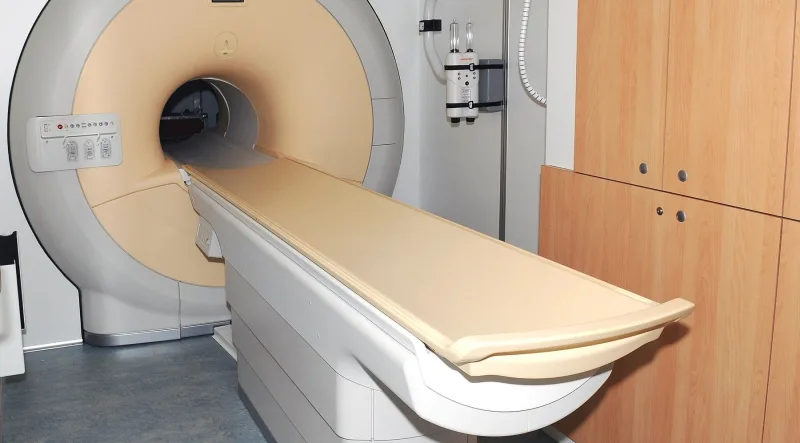
Magnetic resonance imaging (MRI) is a method that produces detailed images of the inside of the body using a magnetic field and radio waves; unlike an X-ray, it does not use ionising radiation. During the scan, you lie on a motorised bed that moves into a tunnel-shaped machine; you are asked to keep still, and the machine makes loud noises, so earplugs are provided. The scan usually takes between 15 minutes and an hour. Before the scan, you need to remove any metal items; be sure to tell the staff if you have a pacemaker, an implant, previous operations, are pregnant, have a kidney problem or are allergic to contrast agents. If you are afraid of enclosed spaces, mention it before the scan.
Common terms in the report
- Disc degeneration: The loss of water and thinning of the discs with age. It is very common with ageing and is not necessarily a cause of pain on its own.
- Bulging (disc bulge): A slight outward bulging of the disc around its circumference. It may not press on a nerve.
- Protrusion: The disc core bulging outwards without tearing through the outer ring.
- Extrusion and sequestration: Disc material coming completely out through the outer ring, or a broken-off fragment moving within the canal. These are more marked types of herniation.
- Annular fissure: A small tear in the outer ring of the disc.
- Spinal stenosis: Narrowing of the canal that contains the spinal cord or nerve roots.
- Foraminal narrowing: Narrowing of the openings through which the nerve roots leave the spine.
- Osteophyte: A bony spur caused by arthritis.
- Spondylolisthesis: One vertebra slipping forwards relative to the one below (spondylolisthesis).
- Modic changes: Signal changes seen in the vertebral end plates.
The report and the complaint do not always match
On spinal MRI, disc degeneration, slight bulging or small herniations can also be seen in many people with no complaints. For this reason, whether a finding in the report is the cause of the pain is decided by comparing it with your complaints and examination findings. Of two people with the same MRI image, one may be in a lot of pain while the other has no complaints at all. Conversely, the location and spread of your pain suggest at which level the nerve is affected; this information is matched with the MRI.
Common mistakes when reading a report
- Searching the terms one by one on the internet and imagining the worst-case scenario
- Interpreting the report as "surgery is needed" without an examination
- Thinking about the image separately from the complaint
- Applying an old MRI to the current situation; an MRI taken years ago may not show today's picture
When coming to the examination with an MRI
It is important to bring the images (on CD or as digital images) together with the MRI report; the doctor makes an assessment by looking not only at the report but at the images themselves. Also bring your previous MRI scans, X-rays and reports with you. Previous tests can be valuable for comparison.
What happens after the MRI?
The next step is decided according to the MRI result together with the examination findings: monitoring, non-surgical treatment, an injection or, if considered appropriate, a surgical plan. A finding on MRI does not automatically mean surgery.
Emergencies
If, while waiting for an MRI, symptoms such as loss of bladder or bowel control, numbness in the genital area or sudden loss of strength in the leg develop, go to the nearest emergency department without waiting for an appointment.
How to read an MRI report: frequently asked questions
If my MRI says "herniation", do I need surgery? No. Many people found to have a herniated disc find relief with non-surgical treatment. The decision about surgery is not based on a single line of the report but on your complaints and examination findings.
Is a contrast agent always needed? No. Most spinal MRI scans are done without contrast. Contrast may be used in certain situations, such as assessing an infection, a tumour or areas that have previously been operated on.
How long will it take to get my MRI result? This depends on the imaging centre. You can find out from the centre where the scan was done when the result will be ready.
Questions to ask your doctor after the report
- Do these findings explain my complaints?
- Is there pressure on a nerve, and if so, at which level?
- Is non-surgical monitoring enough for now?
- When will a new MRI be needed for follow-up?
- Which movements should I avoid, and which can I continue?
Writing these questions down in advance and taking them to the examination makes it easier to get clear answers in a short time. Keeping a copy of the images and the report is valuable for comparison in the future.
The findings listed in the report are usually a neutral list of what the radiologist sees on the images; their clinical significance is interpreted by the doctor who examines you. For this reason, avoid looking up report terms on the internet and drawing your own conclusions; ask about your concerns during the examination.
When is an MRI repeated?
If your complaints have not changed or are improving, repeating the MRI often is usually not necessary. Up-to-date imaging may be requested in situations such as new weakness, a marked increase in complaints or a surgical plan.
How to read an MRI report: when should you seek care?
To find out what your MRI report means and to discuss the treatment options suitable for you, you can come for an examination with your images and report. You can call +90 501 321 12 13 to make an appointment.
This article is for general information only and does not replace an individual diagnosis or treatment. An examination is needed for a diagnosis and treatment decision.