

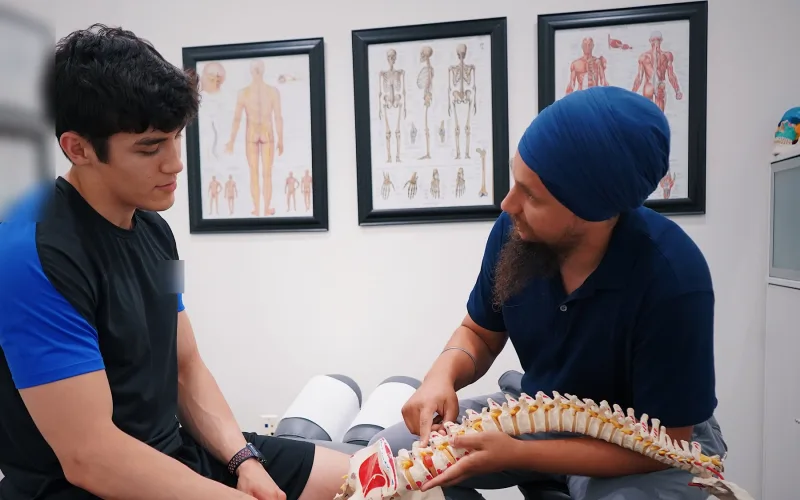
A herniated disc is rare in children and teenagers, but it can occur because of sport, injury or heavy loads. We explain the symptoms and the approach.
A herniated disc is mostly seen between the ages of 30 and 50 and is rare in children and adolescents. However, if a young person has lower back or leg pain, it should not be dismissed with "they're too young, it can't be a herniated disc". In this article, we explain the causes, symptoms and approach to herniated discs in children and young people.
Why is it rare, and when can it occur?
In young people, the discs between the vertebrae do not yet show age-related wear; for this reason, disc herniation is much less common than in adults. According to published reviews, the main causes of herniation in children and adolescents are trauma and sports injuries; repeated strain may also play a part. The load on the lower back can increase with heavy lifting, high-impact sports, gymnastics and similar disciplines.
Herniated discs in children and teenagers: symptoms
- Low back pain; pain that gets worse particularly when bending forward, sitting or coughing
- Pain, numbness or tingling spreading to the leg
- Weakness in the leg, limping or a change in walking
- Restricted movement of the lower back and difficulty standing up straight; the child being unable to bend forward
- Sleep and school or sports performance being affected
In children, the symptoms may differ from those in adults; neurological signs may not always be obvious. This is why the diagnosis can sometimes be delayed. A child being unable to describe their pain can also make diagnosis harder; a child who keeps holding their back, avoids sport or limps should be taken seriously.
Not every case of back pain is a herniated disc
Back pain in children can also have other causes: muscle strains, posture problems, curvature of the spine, slippage of the vertebrae or carrying heavy bags incorrectly. For this reason, the cause of the pain is investigated with an examination and, if necessary, imaging.
Diagnosis
A detailed history and a neurological examination are essential for the diagnosis. If considered necessary, an MRI is requested. In children, the decision about imaging is made carefully; not every case of pain needs an MRI.
Treatment approach
As a first step, a non-surgical approach is usually tried: rest and temporarily reducing activity, medication and physiotherapy. However, reviews report that non-surgical treatment may work less well in children than in adults, and that spontaneous shrinkage of the herniation, as seen in adults, may happen less often. Surgery (microdiscectomy) may be considered for pain that continues despite appropriate non-surgical treatment or for progressive neurological signs. The same reviews report post-operative improvement in pain and function scores in adolescents who had surgery; however, these results are not an individual guarantee, and the decision is made together with the patient and their family.
Advice for families
- Do not dismiss your child's complaint of pain, but do not panic either.
- Do not overload the school bag, and make sure the bag is evenly spread across both shoulders.
- Limit long periods of sitting and screen time; encourage an active life.
- For children who do sport, make sure the training load is increased gradually and that they warm up properly.
- Do not push the child to do strenuous sport while the pain continues; wait for a doctor's assessment.
Situations that require emergency care
If there is inability to hold urine or stools, sudden weakness in a leg, complaints in both legs at once, numbness in the genital area, severe back pain together with fever, or pain that started after a serious fall or accident, go to the nearest emergency department without waiting.
What happens at the examination?
At the examination, you are asked when the child's pain started and about their sport and school habits; spinal movements and strength, sensation and reflexes in the legs are assessed. If necessary, imaging is carried out. The monitoring and treatment plan is discussed with the family. A parent needs to attend the examination with the child.
Herniated discs in children and teenagers: frequently asked questions
Is back pain in adolescence always a herniated disc? No. There are more common causes, such as muscle strain, posture problems and curvature of the spine. A herniated disc is one of the less common causes of back pain in young people.
Can a young athlete with back pain carry on with sport? If the pain continues, it is better to take a break from sport and be assessed. The time to return to sport is decided according to the examination.
Is it harmful for a child to have an MRI? MRI does not involve ionising radiation. Because it can be difficult for young children to keep still, a sedative or anaesthesia is sometimes needed; this is discussed with the relevant team in advance.
The decision about surgery and afterwards
In children, the decision about surgery is made with the involvement of the family and the young patient, after discussing all the options. When a microdiscectomy is needed, the procedure is done under a microscope through a small incision, as in adults. After surgery, the time to return to school and sport is decided by the doctor according to the recovery and the procedure performed. During this period, family support, regular check-ups and a gradual increase in activity are important. Listening to your child's worries and explaining the process in language appropriate to their age also makes recovery easier.
When children and young people have back pain, a question parents often ask is whether a heavy school bag is to blame. The weight of the bag alone is not a cause of a herniated disc; however, constantly carrying the bag on one shoulder and having it too heavy can affect posture and the load on the lower back. Making the bag lighter and spreading it evenly across both shoulders is a useful measure.
Herniated discs in children and teenagers: when should you seek care?
If your child's or teenager's back pain has lasted for a few weeks, is spreading to the leg, or you have noticed a change in the way they walk, you can call +90 501 321 12 13 to arrange an examination.
This article is for general information only and does not replace an individual diagnosis or treatment. An examination is needed for a diagnosis and treatment decision.